
The Camera Doesn't Care That You're Shy
On forcing yourself out, and what the street gives you when you do

I have a complicated relationship with photo walks.
Not with photography — with the walk part. The part where you're out there, visibly carrying a camera, and people can see that you're looking. There's something exposing about it. Like you've announced yourself. Like you owe the street something now.
I'm better behind glass. A car window, a café, home, a comfortable distance. I notice things from there. I just don't always commit to them.
That evening I had gone to J. P. Nagar for a puppet show at Ranga Shankara. The show was the plan. The camera was habit. But somewhere between home and the theatre, the light turned — that deep, unhurried gold that Bengaluru saves for its old neighbourhoods — and I made a deal with myself. Thirty minutes. Just walk. In Jayanagar.

What I didn't expect was that Jayanagar would feel both familiar and completely new. I grew up knowing this part of the city in the way you know a relative you don't visit enough. The bones are the same. The temple with its yellow gopura, the fruit vendors with their impossible colours, the trees that arch over the main road like they're trying to keep something in. But I had never looked at it with intention before. Never showed up with nothing to do except see.
That's what the camera actually does, I think. It doesn't just record. It gives you permission to stand still in public without explanation.
And then this boy came running.
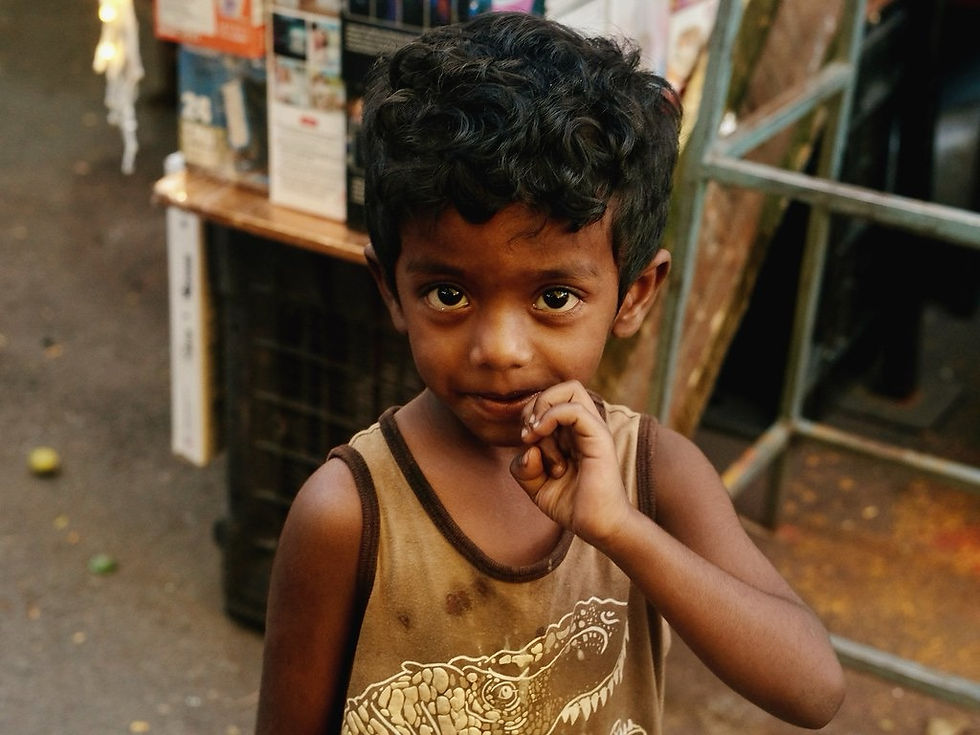
Not waiting to be invited. He saw the camera from somewhere and just ran toward it — full sprint, those eyes completely unguarded. I clicked. He disappeared just as fast, back toward his mother, telling her loudly that someone had photographed him.Thrilled. Like being seen was the whole point.
I stood there for a second after he left. Something about the ease of it. The complete absence of self-consciousness. He wanted to be in the frame. He just went and got into it.
I spent the next twenty minutes trying to do the same thing — just go towards it.
The old man with the bicycle near the famous Ganapati temple. The junction where three kinds of traffic negotiate their way through each other with surprising patience.

The vendor standing under that violent yellow tarpaulin, helmet still on, selecting fruit like he had all the time in the world.

Then the sun. It was dropping behind a man walking straight toward me, and it exploded through the trees in a way that felt almost aggressive. Lens flare, blown highlights, a photographer's list of problems. I had a brief, familiar instinct to fix it — mentally reaching for something to bring it under control.
I let it go. Shot it exactly as it was.

There's a version of photography that's about control. Getting the light right, the exposure right, the moment clean and composed. I respect that version. But some evenings the street hands you something messy and alive and the only honest response is to accept it on its terms.
Thirty minutes. No plan. A boy who ran toward the camera, a sun that didn't behave, and a neighbourhood I thought I already knew.
I drove home later and sat with the images for a while. Not for editing editing. Just looking.
That feeling — of having actually gone, of having stood on the street with intention — it doesn't come from the photographs. The photographs are just proof that it happened.
The feeling comes from overruling the part of you that wanted to stay far from the street.

Comments